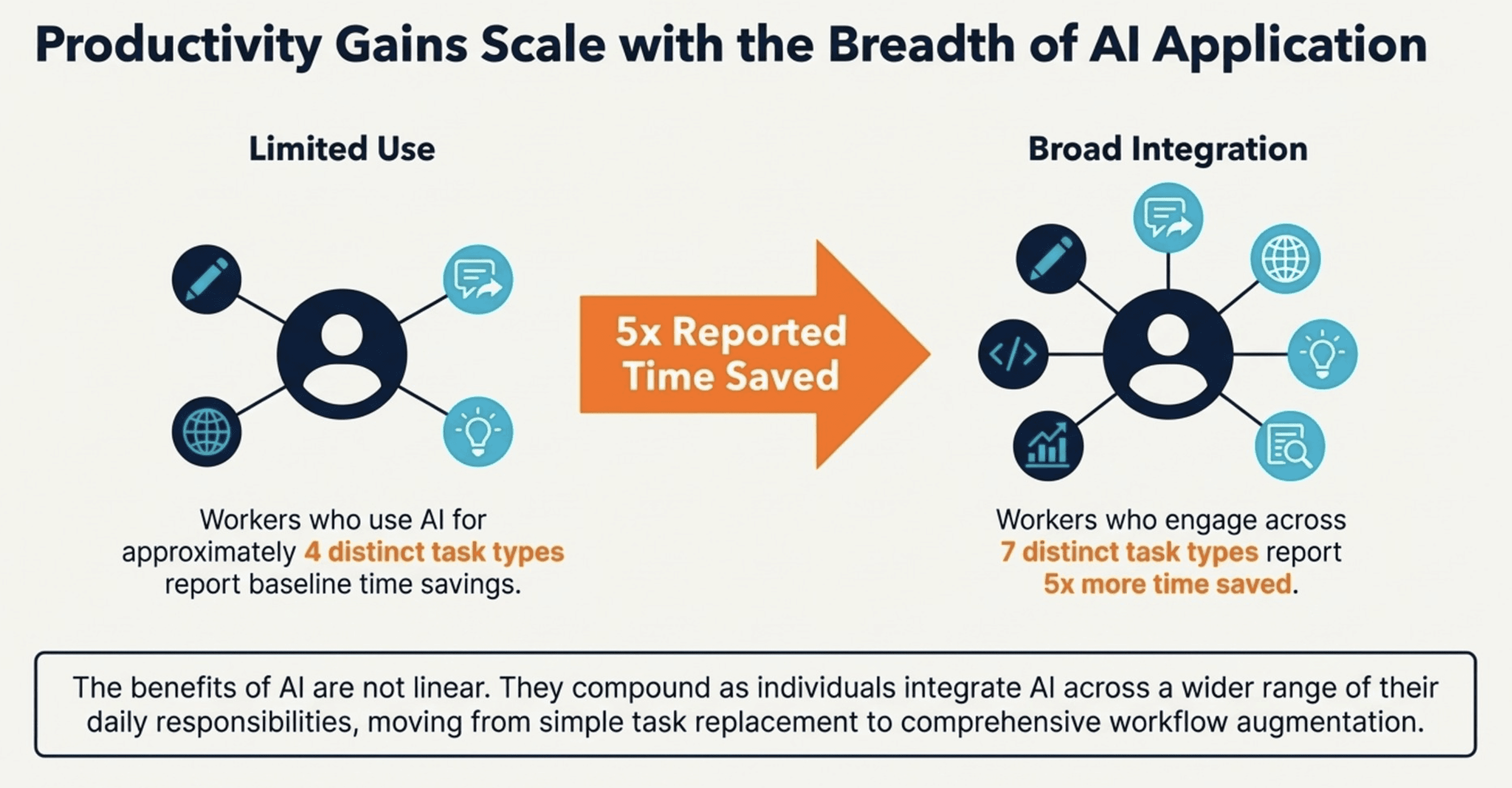
Graphic by Hassan Swidan; data from OpenAI, The State of Enterprise AI, 2025
OpenAI published The State of Enterprise AI in late 2025, a data-backed account of how organisations are moving from experimentation to scaled deployment and what workers are actually gaining in day-to-day productivity and capability. I used an AI research tool to accelerate the synthesis and translated the findings into a short slide pack.
Three takeaways from my reading. First, enterprise AI has moved from pilot to core infrastructure. The shift is not just more usage; it is deeper workflow embedding through repeatable, multi-step patterns such as reusable assistants, integrated workflows and standardised ways of working.
Second, productivity gains are now measurable, and they compound with depth of use. Time savings and quality improvements show up across IT, marketing, HR, engineering and finance. The strategic point is non-linearity: value accelerates when firms expand from isolated tasks to broad workflow coverage and advanced capabilities such as reasoning, research, analysis and automation. Workers using AI across seven task types report five times the time saved of those using it across four.
Third, an AI performance chasm is emerging. The differentiator is increasingly integration depth, standardisation and organisational readiness, meaning governance, data access and enablement, rather than access to tools.
The report’s case studies span customer operations, retail, hiring, healthcare and life sciences, from real-time AI voice workflows in support to research and planning cycles compressed from weeks to materially shorter timelines.
Source
Have a question these don’t answer?
For advisory, training and speaking enquiries, or a conversation about a decision you are weighing.